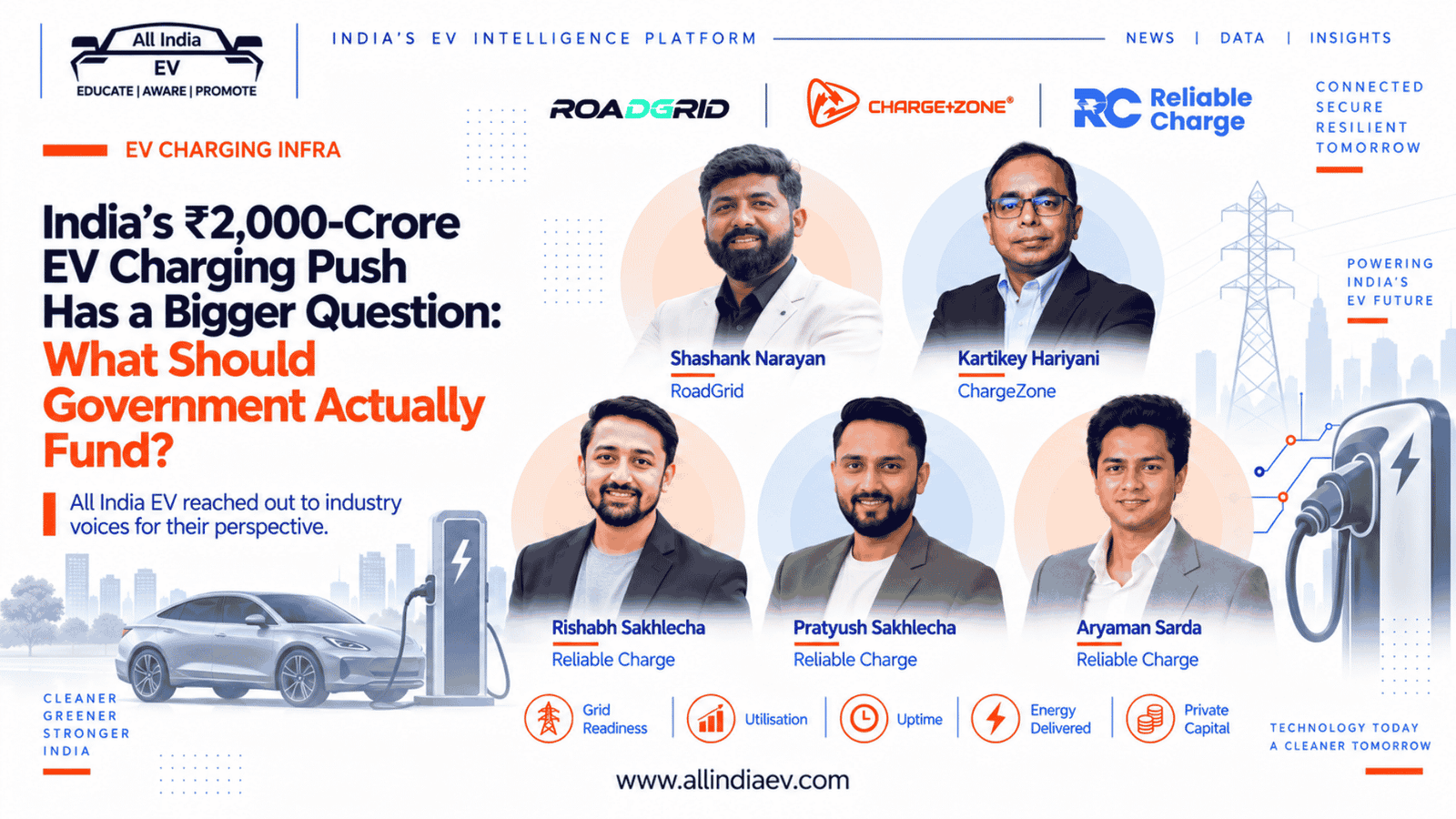
A fresh study has raised questions about India's electric vehicle charging plans. The ₹2,000 crore earmarked for charging under the PM E-DRIVE scheme may support less than 2% of the 1.32 million chargers the country is projected to need by 2030.
Three charging companies — Reliable Charge, ChargeZone and RoadGrid — were asked what this gap means for their business. Their combined view: the government is backing the wrong part of the system.
Starter Money, Not Full Funding
Reliable Charge's founders see the allocation as catalytic capital. Its purpose, they say, is to reduce risk at early sites so that private investors follow. It was never designed to build the entire network on its own.
Charger Counts Are a Poor Scoreboard
All three firms dislike measuring progress by installed units. ChargeZone's Kartikey Hariyani points out that a driver on a highway simply wants a plug that works. RoadGrid's Shashank Narayan goes further, saying terms like sanctioned, installed, commissioned and usable should not be treated as identical. He prefers tracking energised capacity, energy delivered, verified uptime and completed sessions.
The worry is real. A 2024 study found 84% of chargers sampled in Delhi were not functioning.
The Plug Is Not the Costly Part
Setting up a public station costs far more than the charging unit. RoadGrid estimates that grid-related work — sanctioned load, transformers, substations, power company processes, land and civil construction — makes up 50 to 60% of the total. The charger accounts for roughly 40%.
A well-equipped station typically needs ₹20 to 30 lakh to start, once land, power infrastructure and approvals are counted. Running costs add strain as well. Demand charges, levied on sanctioned load even when no power is drawn, range from zero in states like Andhra Pradesh and Rajasthan to ₹309 per kVA in Tamil Nadu.
One Shared Fix: Fund the Grid First
The companies broadly agree on the remedy. Public money should pay for substations, transformers, cable routes, land and quick power connections. Private operators can then put their own capital into chargers, software and maintenance, since lenders already finance hardware.
ChargeZone adds two asks: cheaper long-term loans for grid work, and a cut in GST on public charging and battery swapping from 18% to 5%. On measurement, the firms favour judging operators on uptime, successful sessions and how quickly faults are fixed.
Why It Matters
For EV owners, this debate shapes how soon working chargers reach highways and city streets. If policy shifts towards usable capacity and delivered energy, drivers could face fewer dead units and more reliable journeys.
The Bigger Question
The core issue is who carries which risk, not the size of the fund. If policymakers listen, future support may flow into grid capacity, with success judged by the private investment it unlocks rather than the chargers it directly pays for.