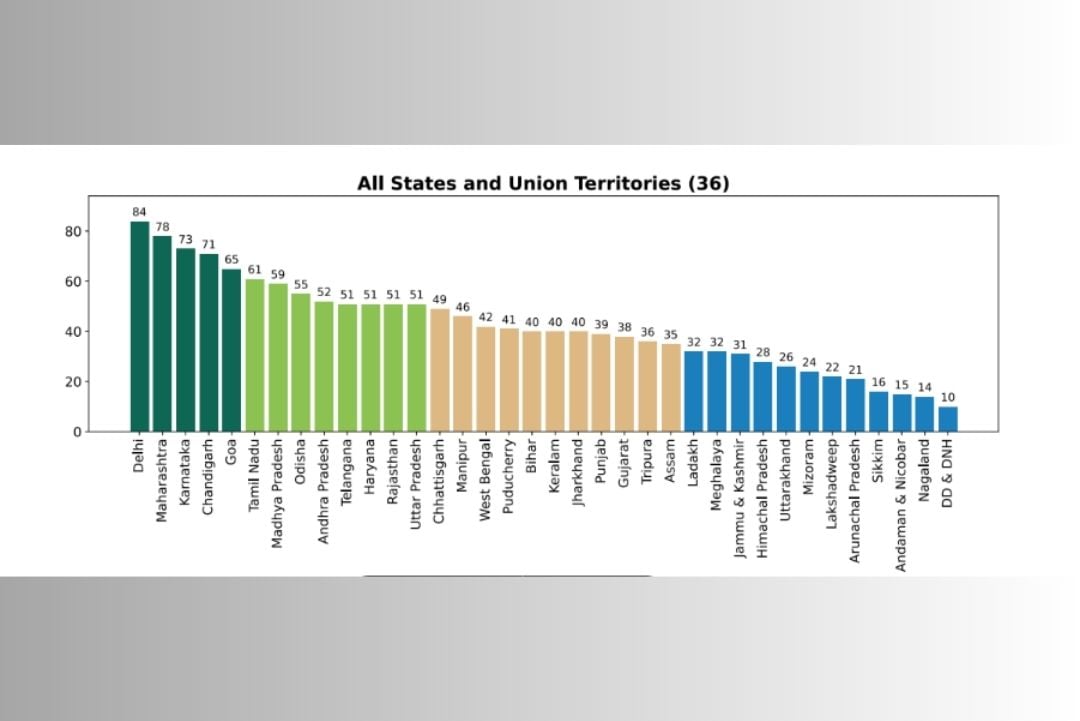
Delhi has secured the first position among all states and Union territories in the 2025 edition of the India Electric Mobility Index. NITI Aayog released the ranking in New Delhi on September 16. Maharashtra, Karnataka, Chandigarh and Goa complete the top five in this second round of the index.
What the Index Measures
The IEMI works as a state-level tool to follow progress on electric mobility. It judges each state and Union territory through indicators spread across three themes: electrification of transport, preparedness of charging networks, and activity in research and innovation.
The earlier edition of the index covered 28 states and eight Union territories, using 16 indicators in total.
Scores Have Climbed
Numbers show gains across the country. The highest score has moved up from 77 to 84, while the median has risen from 36 to 40.
These figures were shared by Rajiv Gauba, a member of NITI Aayog, at a workshop the body organised on state EV policies.
Why Electrification Is a Priority
Gauba called the move towards electric mobility an economic, environmental and strategic necessity linked to the Viksit Bharat 2047 goal. He underlined India's heavy reliance on foreign crude, noting that close to 89% of the country's crude needs are met through imports.
The automobile sector, he said, contributes around 7.1% to the GDP and supports jobs for nearly 1.9 crore people.
Government backing for electric mobility has gone past ₹92,000 crore. This funding flows through schemes like FAME, PM E-DRIVE and PM E-bus Sewa, besides production-linked incentives for vehicles, auto components and advanced battery storage.
States Are Not Moving at the Same Pace
Adoption varies widely, Gauba observed. Differences in industrial strength, finances and geography explain why some states score better than others.
He advised states to share good practices with each other, choose certain cities for converting public transport to electric, and work on spreading charging points more evenly while making them reliable. He also wanted higher investment in research and innovation.
Charging Access Is Expanding
Oil marketing companies and private players are putting up more charging stations. A new application, Unified Bharat e-Charge, aims to help drivers find and access chargers with ease.
Globally too, the shift is visible. Electric cars took roughly one-tenth of new car sales in the United States in 2025, above a quarter in the European Union, and over half in China.
Road Ahead
So far, 29 of India's 36 states and Union territories have notified EV policies. As more states act, the distance between front-runners and those lagging could shrink in coming editions of the index.